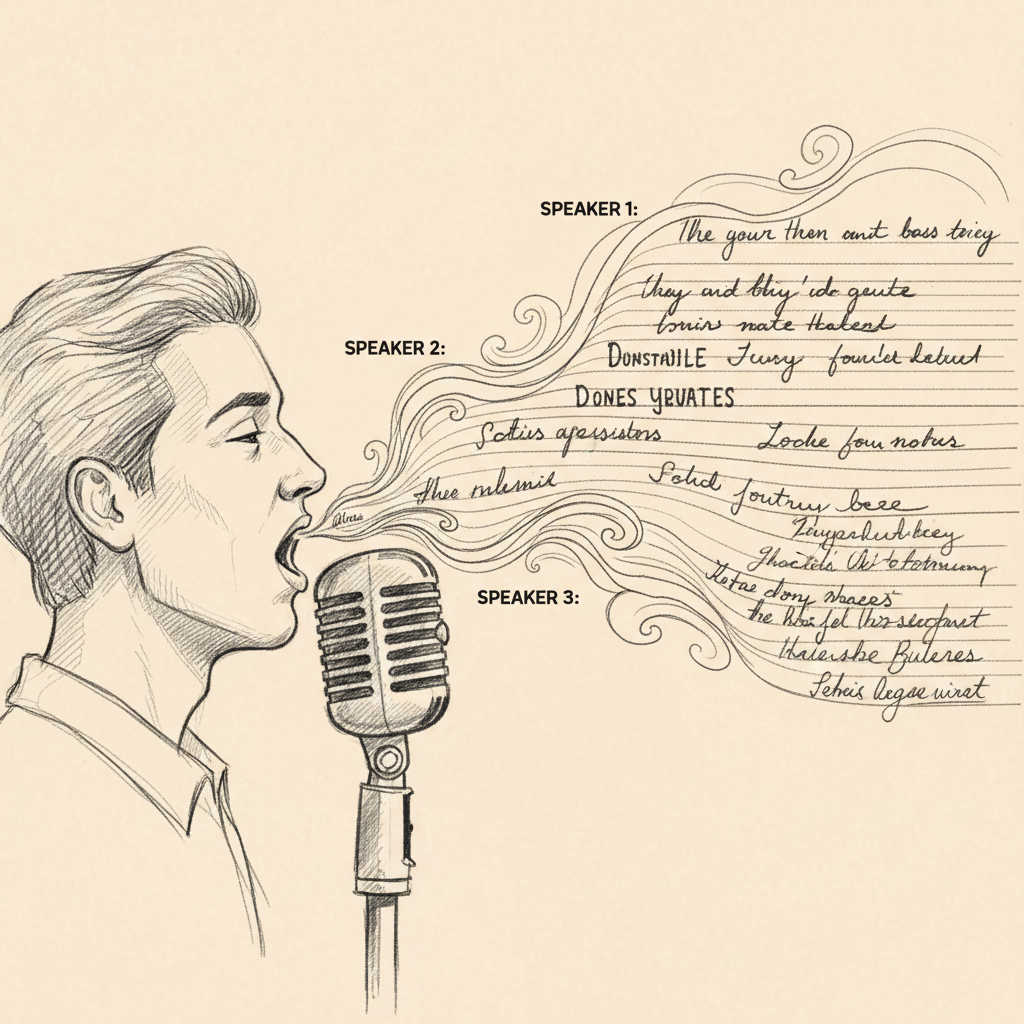
Microsoft open-sources a speech model that hears who said what — and when
What Happened
Microsoft open-sourced VibeVoice-ASR on January 21, 2026 — an approximately 8-billion-parameter speech recognition model that does something no comparable open model has managed before: it handles transcription, speaker identification, and timestamps all in one step, natively, across up to 60 continuous minutes of audio.
To understand why that matters, a brief definition of terms. ASR, or automatic speech recognition, is the technology that converts spoken words to text — what powers voice-to-text on your phone. Diarization is the separate problem of figuring out who said each thing. Timestamps tell you when. Those three tasks — what, who, and when — have historically required three separate AI models working in sequence, each with its own errors that compound through the pipeline.
VibeVoice-ASR collapses all three into a single processing pass. On LibriSpeech, the standard benchmark for transcription accuracy, it achieves a word error rate (WER) of 2.20% on clean audio — a measure of how often the model gets a word wrong, where lower is better. The model processes audio at 51.8 times faster than real time: a 60-minute meeting transcribes in roughly 70 seconds on compatible hardware. It supports 50-plus languages and can handle speakers switching between languages mid-sentence, a capability called code-switching. Built on the Qwen2.5 7-billion-parameter language model base with acoustic processing components (encoder and decoder, each roughly 340 million parameters), it became available via Hugging Face Transformers on March 6, 2026. The technical report, authored by a 24-person Microsoft Research team led by Zhiliang Peng and Jianwei Yu, is available at arXiv:2601.18184.
One caveat that Microsoft states directly: the GitHub repository for VibeVoice flags that the model is "not recommended for commercial or real-world applications without further testing." This is a research-stage release.
Why It Matters
Until VibeVoice, building a tool that could transcribe an hour-long meeting and identify who said what required assembling at least three AI models: a transcription model like OpenAI's Whisper, a diarization model from a separate library, and an alignment tool to synchronize the two outputs. Each handoff introduced errors, and none of the three models were designed to share information with the others. When a transcription model cuts audio into 30-second chunks — as Whisper does natively, because its context window is limited — it loses the conversational thread across those boundaries. Speaker identification applied after the fact frequently gets confused when recordings run long or speakers overlap.

VibeVoice solves that integration problem by design. Because it processes up to 60 minutes in a single pass using a 64,000-token context window, it maintains context across the full recording. Its structured output — labeled per speaker turn with identity and timestamp — is directly usable for meeting summaries, legal depositions, podcast transcripts, and interview notes without post-processing.
The accuracy comparison with the dominant open alternative is worth stating plainly. On pure transcription averaged across eight standard Open ASR Leaderboard benchmarks, VibeVoice (7.77% average WER) trails Whisper large-v3 (approximately 7.4%, per the 2026 Northflank benchmark roundup). Whisper is also considerably smaller at 1.55 billion parameters and supports more languages (99 versus VibeVoice's 50-plus). For short-file transcription without speaker identification, Whisper remains competitive. VibeVoice's meaningful advantage is the native speaker identification layer — Whisper has none — and its ability to handle long-form audio without chunking.
The hardware requirement is a real constraint: VibeVoice needs a minimum of 24 gigabytes of GPU memory, placing it firmly in cloud infrastructure territory rather than local or edge deployment. For organizations that can meet that threshold, the MIT license means no per-minute usage fees and no audio data leaving a controlled environment — a material advantage over commercial services like Deepgram Nova-2 ($0.0043 per minute) or Google Chirp, both of which route audio through external servers.
If the model passes Microsoft's own production-readiness bar, it could become a standard foundation for any application where knowing the speaker is as important as knowing the words.
Sources
- T1
- T1
- T1
Stay informed. The best AI coverage, delivered weekly.