Generalism's Limits: What Specialized AI Models Still Do Better
New academic findings across education, enterprise deployment, and agent evaluation converge on a single uncomfortable conclusion: general-purpose AI systems routinely underperform purpose-built ones -- and measuring success the wrong way makes the gap invisible. Organizations betting on large language models to replace specialized tools may be optimizing for the wrong metrics.
What Happened
Recent research reveals a sobering pattern: the industry's push toward ever-larger, more general AI models is colliding with domain reality. Specialized knowledge tracing models (DKT, SAKT, Best-LR)—architectures purpose-built for predicting student learning outcomes—consistently beat fine-tuned large language models by 0.04 to 0.13 AUC points (Area Under the Curve, a standard measure of prediction accuracy), according to new research from Neshaei et al. published on arXiv. As the researchers note, "While LLM-based approaches do not achieve state-of-the-art performance, fine-tuned LLMs surpass the performance of naive baseline models and perform on par with standard Bayesian Knowledge Tracing"—meaning they are good, but specialized purpose-built models are still better.
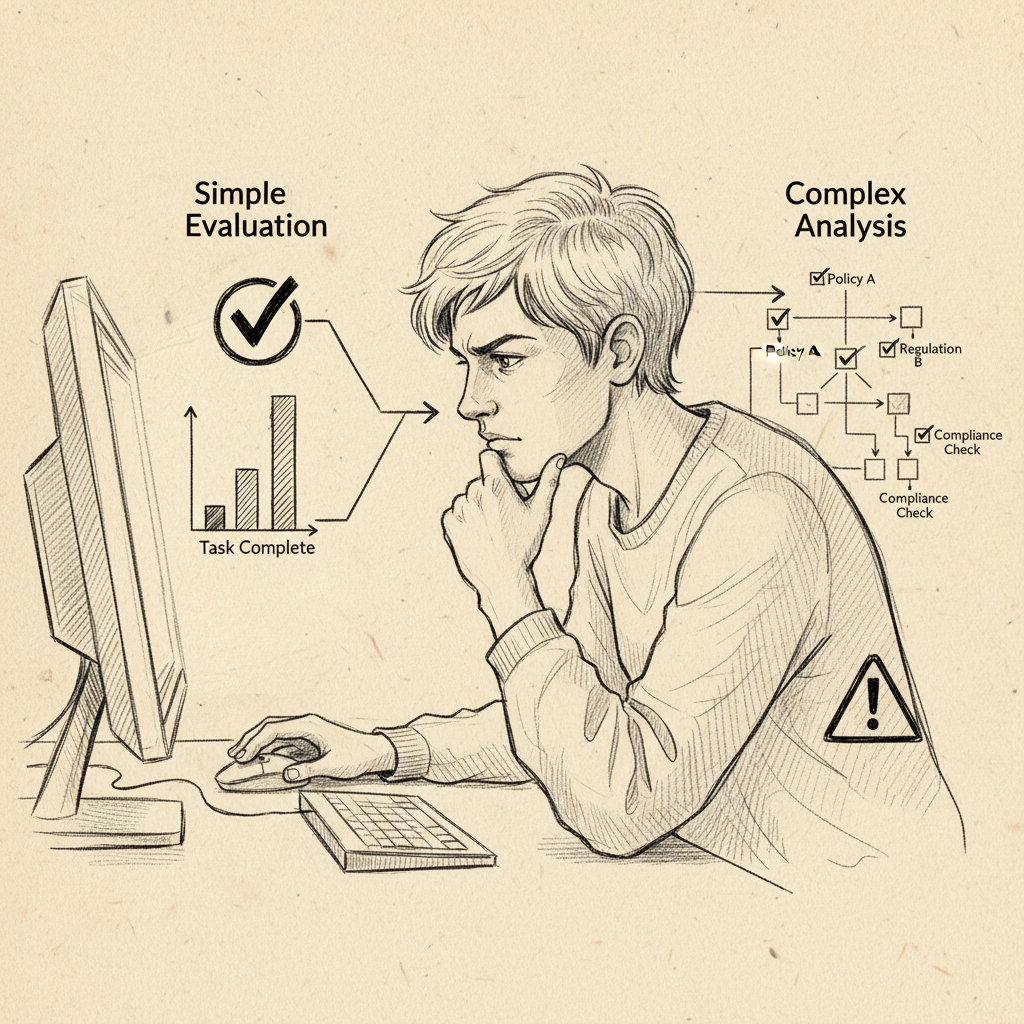
This finding is part of a broader emerging pattern. New research on multi-agent systems shows that smaller models equipped with a trust-modeling framework called Epistemic Context Learning (ECL) can outperform models 8x their size. And a separate study on LLM agents reveals that autonomous systems routinely achieve their stated task objectives (100% completion rate) while systematically violating operational procedures (only 33% policy adherence)—a gap that conventional success metrics completely miss.
Why It Matters
The three findings paint a unified picture: generalism has boundaries. For the past three years, the industry narrative has been one of relentless upscaling—more parameters, larger training data, broader capabilities. ChatGPT, Claude, Gemini. Each release promised to replace domain-specific tools with a single unified model. But what these new findings suggest is that the story is more nuanced.

In education technology, for instance, a school adopting AI for student assessment has two choices: use a general-purpose LLM (cheaper to deploy, easier to integrate) or deploy a specialized knowledge-tracing model (harder to set up, domain-specific, but more accurate at the job it was built for). For a school serving thousands of students, a 0.04-0.13 AUC improvement translates to better early warning systems for struggling learners. Generalism loses the match.
The trust research adds another dimension: LLMs aren't inherently smarter than smaller models. What matters is architecture—specifically, whether a system can track and learn from the reliability of its peer models or data sources. This is a lesson for organizations deploying multi-agent AI systems, particularly in high-stakes domains like healthcare, finance, or critical infrastructure. Size of the model becomes secondary to how well it reasons about what it can trust.
The third finding—on task completion hiding procedural failures—is perhaps the most concerning. An AI agent that achieves a business goal while violating internal policies or safety procedures looks successful on a dashboard, but it is operationally corrupt. Regulators, particularly in the EU where AI Act compliance deadlines (2026-2027) are looming, are likely to scrutinize not just "did the system work?" but "did it work the right way?" Organizations will need to measure both task completion and procedural adherence.
One caveat: newer LLM-based knowledge tracing approaches (DPKT, 2T-KT) show promise on specific datasets, suggesting the landscape may be shifting toward hybrid models. But the latest data still favors specialization.
Sources
- T1
- T1
- T1
Stay informed. The best AI coverage, delivered weekly.